Home / Articles / Beach homes
A dehumidifier in the beach apartment: when it helps, what it does not solve and the ideal humidity
By Lucy Home. Published 14/11/2026, updated 14/11/2026.
A dehumidifier helps in a beach apartment when the problem is still, humid air in a closed room; it does not fix seepage, leaks or mold that has already settled in. That is how I answer when a client asks whether it is worth buying one to protect the sofa and the table. In this guide I explain what the ideal humidity is according to the public sources I use, what humidity does to upholstery and wood, what to expect from the appliance and, above all, how to measure instead of guessing.
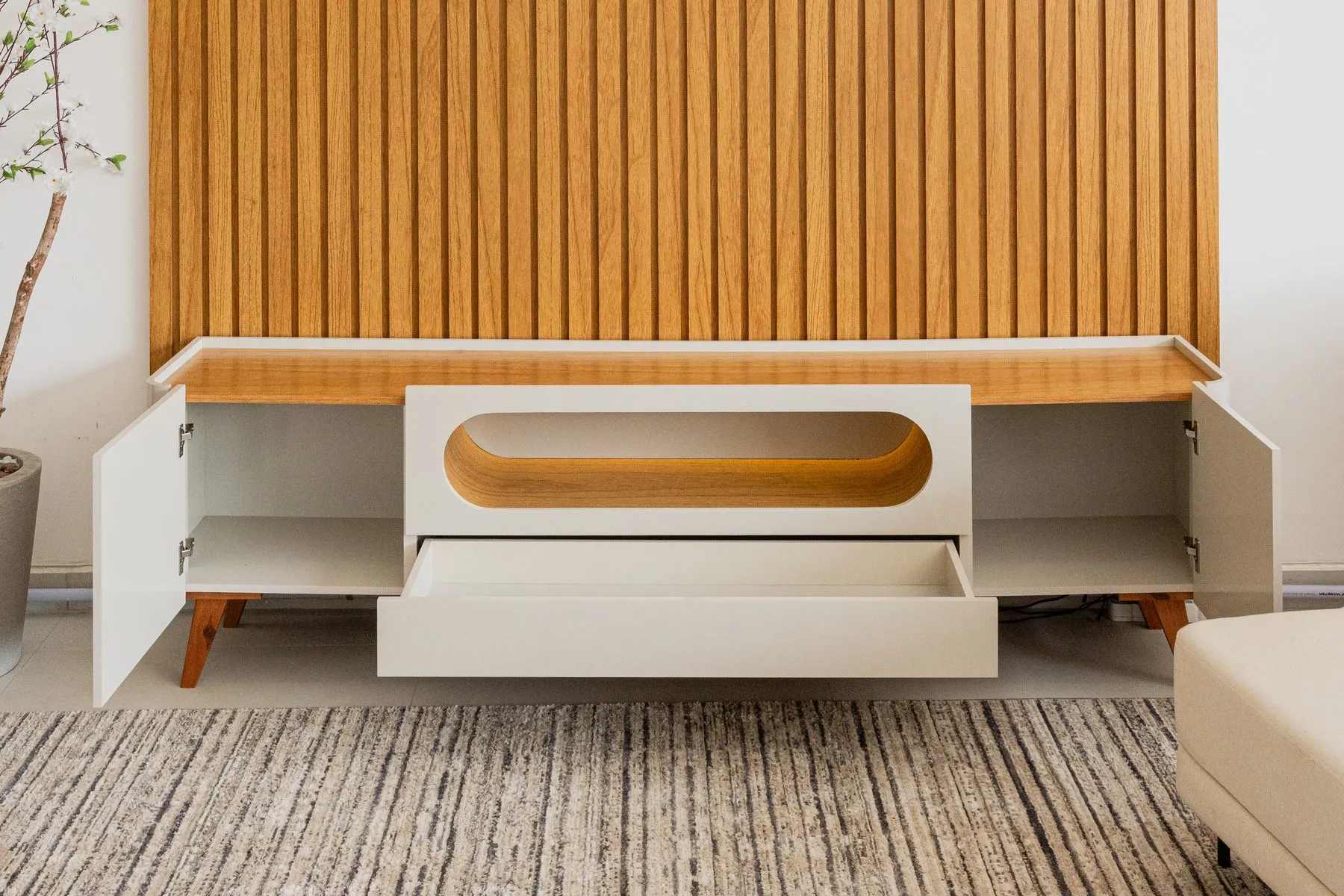
TV unit with doors, a drawer and a wood panel at the Lucy Home showroom: doors and drawers are the first to tell you the wood has swollen with humidity.
What the ideal indoor humidity is
My reference comes from two US public sources, because I found no Brazilian open guidance with a number. The Environmental Protection Agency (EPA) recommends keeping indoor humidity below 60 percent, ideally between 30 and 50 percent. The CDC says no higher than 50 percent all day long.
Now the coastal number: INMET’s climatological normal for 1981-2010 records, at the Santos station, an average annual relative humidity of 81.5 percent, with months ranging from 79.6 percent (December) to 83.3 percent (September). There is no INMET station in Praia Grande with open data, so I use the neighboring city and say so. The city of Sao Paulo sits at 74.3 percent. The math is simple: the air coming through the window is already thirty points above what the home would like to have inside. With people at home and windows open, the air renews itself and the gap is manageable. With the apartment closed for weeks, humid air sits against the upholstery and the wood.
What humidity does to the sofa and to wood
Upholstery. Foam and fabric hold moisture. Mold needs water and material to grow, and the EPA explains that it forms where air does not circulate, including on the wall behind furniture pushed against it. The CDC says soaked upholstery that could not be dried within 24 to 48 hours should be removed or replaced. Constant high humidity does not soak a sofa overnight, but it keeps the environment in which mold thrives. The guide to mold on sofas and furniture explains what can be cleaned.
Wood. Purdue University, in a text about furniture, explains that wood adsorbs moisture and swells when the air is humid, and loses moisture and shrinks when the air is dry; a finish slows the process but does not stop it. The same source gives the scale: in air at 30 percent relative humidity, wood settles at about 6 percent internal moisture; at 75 percent, at about 14 percent. And it lists what happens to the piece in that back and forth: joints that open, tops that crack, finish that crazes along the glue line, drawers and doors that stick. That is why I say that on the coast a wood table needs a complete finish and a home that does not sit closed for months.
What a dehumidifier does, and what it does not
What it does: it pulls moisture out of the air in the room it is in, with doors and windows closed. The EPA includes air conditioners and dehumidifiers among the resources to use when needed to keep humidity in range. In a beach apartment in use, with outdoor air at 80 percent, that is exactly the use case: close the living room at night, turn the unit on and pull out the excess.
What it does not do:
- It does not fix water coming in. Seepage in a wall, a leak, a window that does not seal, a dripping air conditioner drain: the EPA is clear that the water source has to be fixed, or the mold comes back.
- It does not clean mold. Existing mold is removed according to the material; the appliance only makes new mold harder.
- It does not work with the window open. It dries the air of a closed room; with the home airing, outdoor air replaces the humidity immediately. Ventilate by day and dry by night is the combination I use.
- It does not replace pulling furniture off the wall. The condensation behind the sofa and the TV unit that the EPA mentions depends on airflow in that corner, and no appliance reaches there.
I do not name a brand, model or capacity, because I found no neutral open source to compare them, and because it depends on the size of the room. What I ask is that you measure.
How to measure instead of guessing
The EPA notes that humidity can be measured with a moisture or humidity meter, a small, inexpensive instrument available at many hardware stores. That is the hygrometer. I suggest leaving one in the living room, near the sofa, and writing down:
- The humidity when you arrive at the apartment, with everything closed. That is the home’s worst case.
- The humidity after an hour with windows open on opposite sides.
- The humidity at night, with the living room closed and the dehumidifier or air conditioner running.
If number 3 lands in the EPA’s range and number 1 is far from it, the appliance is doing its part, and the real problem is how long the home stays closed. If number 3 does not come down, look for water: something is adding humidity faster than the appliance removes it.
How I choose furniture for a home that will be humid
The appliance is the second line of defense. The first is the right piece and the right routine. For a beach home, I look at:
- A modular sofa, so you replace one module if it suffers, instead of the whole sofa. Most Lucy Home sofas are delivered that way.
- A treated wood frame and galvanized staples, as the Bali and Diamond spec sheets state.
- Foam with a declared density and fabric with a cleaning code, so you know how to care for it.
- A wood table with a complete finish, including under the top, and furniture pulled off the wall.
- A routine for opening and closing the home, which is in the guide beach house: what to do when you arrive and when you leave.
The article furniture that lasts on the coast covers each item with its sources.
Come and talk about your apartment
Lucy Home is at Av. Presidente Kennedy, 3870, Aviação, Praia Grande. The team knows the spec sheet of every piece and helps you choose what stands up to coastal humidity, with no promise of miracles. Room planning is at no cost: send photos of the living room on WhatsApp and we start there. See also the sofas page and the showroom.
Frequently asked questions
What is the ideal indoor humidity?
The US Environmental Protection Agency (EPA) recommends keeping indoor humidity below 60 percent, ideally between 30 and 50 percent. The CDC says no higher than 50 percent all day long. On the Sao Paulo coast, INMET's normal for Santos (1981-2010) records an annual average of 81.5 percent outdoors, so a closed home tends to sit well above that range.
Does a dehumidifier remove mold?
No. It lowers the humidity of the air, which makes new mold harder, but it does not remove existing mold or fix the water that caused it. The EPA is direct: you have to clean up the mold and fix the moisture problem; one without the other is not enough.
Dehumidifier or air conditioner?
The EPA names both, air conditioners and dehumidifiers, as resources to use when needed against humidity. I found no source that says which is better for a beach apartment, and it depends on the unit, the room and the electricity bill. What I say is: measure the humidity with a hygrometer before and after, and let the number decide.
Can I leave the dehumidifier running when I close the apartment for weeks?
I found no technical source that recommends running an appliance in an empty home, and I do not recommend it on my own. I prefer to fix what does not depend on an outlet: ventilation whenever the home is in use, nothing damp put away, furniture pulled off the wall and someone who opens the windows now and then.
Sources
- EPA (US Environmental Protection Agency), A Brief Guide to Mold, Moisture and Your Home
- CDC (US Centers for Disease Control and Prevention), About Mold
- INMET (Brazil's National Institute of Meteorology), Climatological Normals 1981-2010, relative humidity (station 83782, Santos)
- Purdue University, Carl A. Eckelman, The Shrinking and Swelling of Wood and Its Effect on Furniture (FNR-163)