Home / Articles / Beach homes
Beach house routine: what to do when you arrive and when you leave so the furniture lasts
By Lucy Home. Published 14/11/2026, updated 14/11/2026.
When you arrive at the beach house, open everything before you put anything away; when you leave, leave everything dry, clean and pulled away from the wall. That is the whole routine in one sentence. The rest of this guide explains why the coast asks for this care, what to do at each point of the season, and how each material in the house, wood, metal and upholstery, reacts to humid air. I write for the people I see most often at Lucy Home: families who live in Sao Paulo and come down to Praia Grande on weekends and holidays.
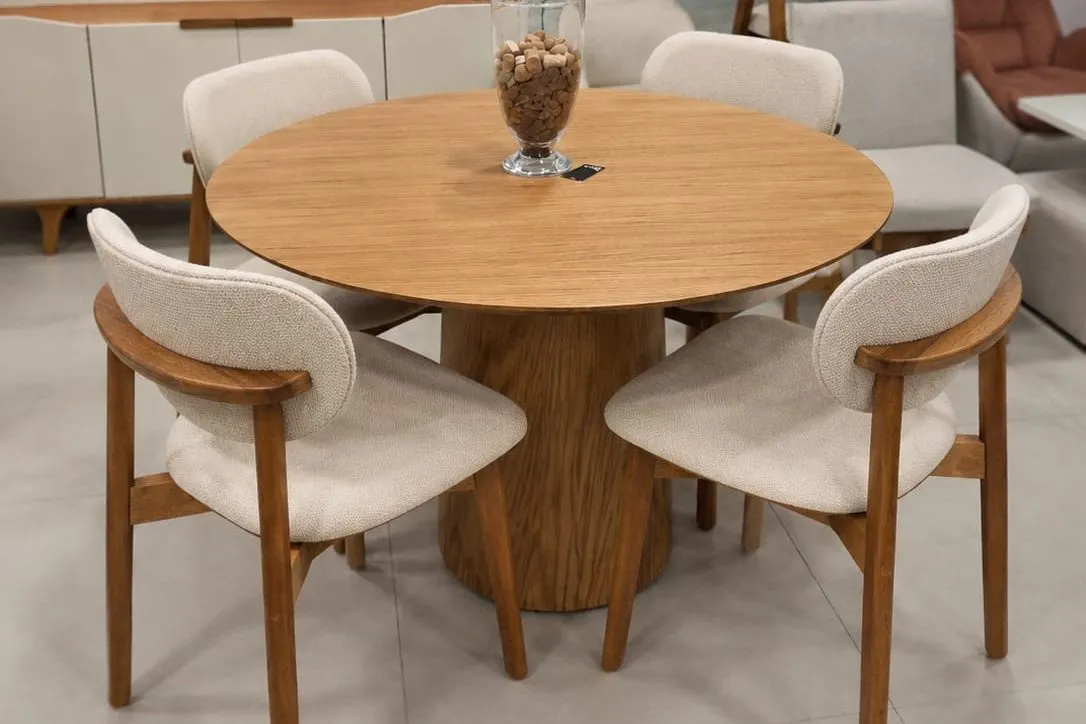
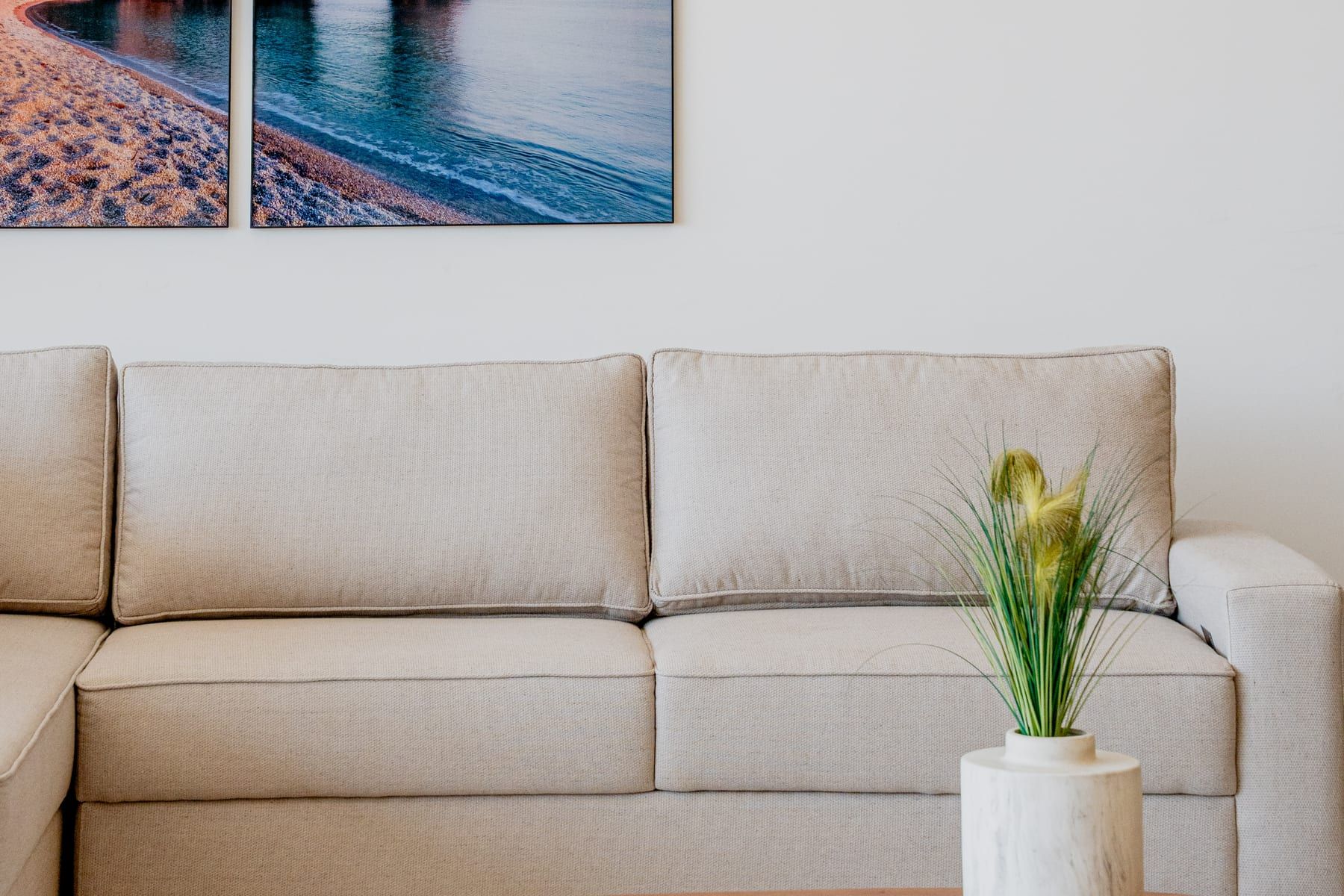
Wood table and upholstered chairs at the Lucy Home showroom: the two materials that most need a routine in a house closed for part of the year.
Why a beach house needs a routine
Two numbers explain it. The first is air humidity: in the INMET climatological normal for 1981-2010, the Santos station, the closest to Praia Grande with open data, records an average annual relative humidity of 81.5 percent, with no month below 79 percent. In the city of Sao Paulo (Mirante de Santana station) the annual average is 74.3 percent. The second number is the comfort and safety reference for a home: the US Environmental Protection Agency (EPA) recommends keeping indoor humidity below 60 percent, ideally between 30 and 50 percent, and the CDC says no higher than 50 percent. In other words, the air coming through the window at the beach is already well above what the house would like to have inside. With people at home, airing and moving around, that is manageable. With the house closed for weeks, it is not.
That is why, on the coast, furniture is not only a matter of taste. It is a matter of material and routine. The guide to furniture for a beach apartment covers the material; this one covers the routine.
When you arrive: the first hour
- Open windows and doors on opposite sides and let air cross the house before anything else. The EPA lists ventilating and opening windows among the basic measures against moisture.
- Use your nose. A moldy smell with no visible stain, according to the EPA, points to hidden mold: behind furniture pushed against the wall, under the rug, inside a closed cabinet. Follow the smell to the source.
- Pull the furniture off the wall and look behind it. The EPA explains that condensation forms on the wall behind furniture, where air does not circulate, and mold grows there unseen.
- Touch the upholstery and the wood. A cold, damp seat, whitish stains on a tabletop, a drawer that sticks: these are signs the house got too humid. None of it is fixed with room spray.
- Dry anything wet within 24 to 48 hours. That is the window the EPA gives to keep mold from settling into wet material.
- Find the water. A leak in the ceiling, a drain that backed up, a dripping air conditioner: every mold stain has a water source, and the EPA is clear that cleaning mold without fixing the water only postpones the problem.
If you found mold on the sofa or on wooden furniture, the guide to mold on sofas and furniture says what can be cleaned and what cannot.
During the season
With the house in use, the care is lighter, but it exists:
- Cross ventilation every day, especially in the morning, before the sun heats the living room.
- Air conditioning and a dehumidifier when needed. That is the EPA’s recommendation for keeping humidity down. The article on a dehumidifier in a beach apartment explains when it really helps and what it does not solve.
- Wet towels and swimsuits off the sofa. It sounds obvious, but it is the most common way to soak a seat. The CDC says soaked upholstery that cannot be dried right away should be removed or replaced: a damp towel forgotten on a Friday can cost you a sofa module.
- Sand and sunscreen come off the same day. Vacuum the sand, which scratches fabric and leather, and clean sunscreen according to the cleaning code on the sofa’s tag. The guide to caring for leather and fabric sofas explains the W, S and X codes.
- Hot dishes and cold glasses need coasters on a wood table. The condensation running down the glass is the same water that stains the top.
When you close the house
- Clean and dry everything. No damp surface, no wet fabric, no dishes in the rack.
- Pull the sofa, buffet, TV unit and bed a few inches off the wall so air can move behind them.
- Leave cabinet doors and drawers slightly open. This is my habit, so the air inside does not stand still; the EPA talks about ventilation, not drawers, so I record it as a habit, not a standard.
- Cover with cotton sheets, not plastic. Also my preference: cotton keeps dust off and lets air through; plastic holds moisture against the upholstery, and trapped moisture is what mold needs.
- Take the rug out from under the sofa if the house will be closed for months. A rug on a cold floor collects condensation, and the EPA notes that a moldy rug sometimes cannot be saved.
- Shut off the water supply. A leak in an empty house is the worst possible combination.
- Arrange for someone you trust to open the windows now and then if the house will be closed for a long time. No appliance replaces an hour of air crossing the house.
Wood, metal and upholstery: what each one suffers
| Material | What humid air does | What I look for when buying |
|---|---|---|
| Wood | According to Purdue University, wood adsorbs moisture and swells when the air is humid, and loses moisture and shrinks when the air is dry. Finishes slow this down but do not stop it. Joints open, tops crack, drawers and doors stick. | Treated wood, a finish that covers everything (including under the top), a sofa frame in treated plantation wood, as the Bali spec sheet states |
| Metal | Ordinary hardware rusts faster near the sea. The guide to salt air and furniture has the classification by distance from the beach. | Galvanized or stainless hardware; galvanized staples in the frame, as the Diamond spec sheet states |
| Upholstery | Foam and fabric hold moisture; soaked upholstery that does not dry quickly should be removed or replaced, according to the CDC. | Foam with a declared density, fabric with a cleaning code, modules that can be replaced one at a time |
Buying for the beach house while living in Sao Paulo
Most of my clients live in the capital and use their Praia Grande home on weekends. For them, two details make the purchase easier. The first is scheduled delivery: if you live in Sao Paulo or the Baixada Santista you pick the date, and delivery and assembly are already included in the price, so the sofa arrives and is assembled on a day you are at the house. The second is room planning at no cost: you send the floor plan or photos of the living room on WhatsApp, I suggest the pieces and the layout, and you decide calmly, before you come down.
The store has pieces ready for delivery and made to order, with custom color, fabric, size, arm and module. For a beach house I usually suggest a modular sofa: if one module suffers from a forgotten towel, it comes out on its own.
Come and build your routine with us
Lucy Home is at Av. Presidente Kennedy, 3870, Aviação, Praia Grande. Come sit on the sofas, see the tables set up and ask about materials and care with people who know every piece. If you prefer, message us on WhatsApp with photos of the house and we start there. See also the sofas page and the showroom.
Frequently asked questions
How long can a beach house stay closed before the furniture gets moldy?
I found no source that sets a deadline, and I distrust anyone who does. What the US Environmental Protection Agency (EPA) defines is the condition: indoor humidity below 60 percent, ideally between 30 and 50 percent, and anything that gets wet dried within 24 to 48 hours. In a closed house on the coast, where INMET records average air humidity above 80 percent, the math is not about weeks, it is about ventilation and standing water.
Should I leave the air conditioner or dehumidifier running in the closed house?
The EPA recommends using air conditioners and dehumidifiers when needed to keep humidity down, but I found no source that tells you to leave them running in an empty house. I prefer to fix the cause: cross ventilation while the house is in use, nothing damp put away, furniture pulled off the wall and, if the house sits closed for months, someone who opens the windows now and then.
Should I cover the sofa and the table with plastic when I close the house?
This is my preference, not a technical rule: I cover with cotton sheets, which keep dust off and let air through. The EPA notes that trapped moisture is what mold needs, so I avoid any cover that holds damp air against upholstery.
I arrived and the sofa smells of mold. What now?
A moldy smell with no visible stain points to hidden mold, according to the EPA: behind furniture, under the rug or inside the upholstery. Open the house, pull the sofa off the wall and find the source. The CDC says upholstery that was soaked and could not be dried right away should be removed or replaced. Lucy Home's guide to mold on sofas walks through it step by step.
Sources
- INMET (Brazil's National Institute of Meteorology), Climatological Normals 1981-2010, relative humidity (station 83782, Santos)
- EPA (US Environmental Protection Agency), A Brief Guide to Mold, Moisture and Your Home
- CDC (US Centers for Disease Control and Prevention), About Mold
- Purdue University, Carl A. Eckelman, The Shrinking and Swelling of Wood and Its Effect on Furniture (FNR-163)