Home / Articles / Beach homes
Mold on the sofa and furniture: how to remove it, when to give up and how to prevent it at the beach house
By Lucy Home. Published 14/11/2026, updated 14/11/2026.
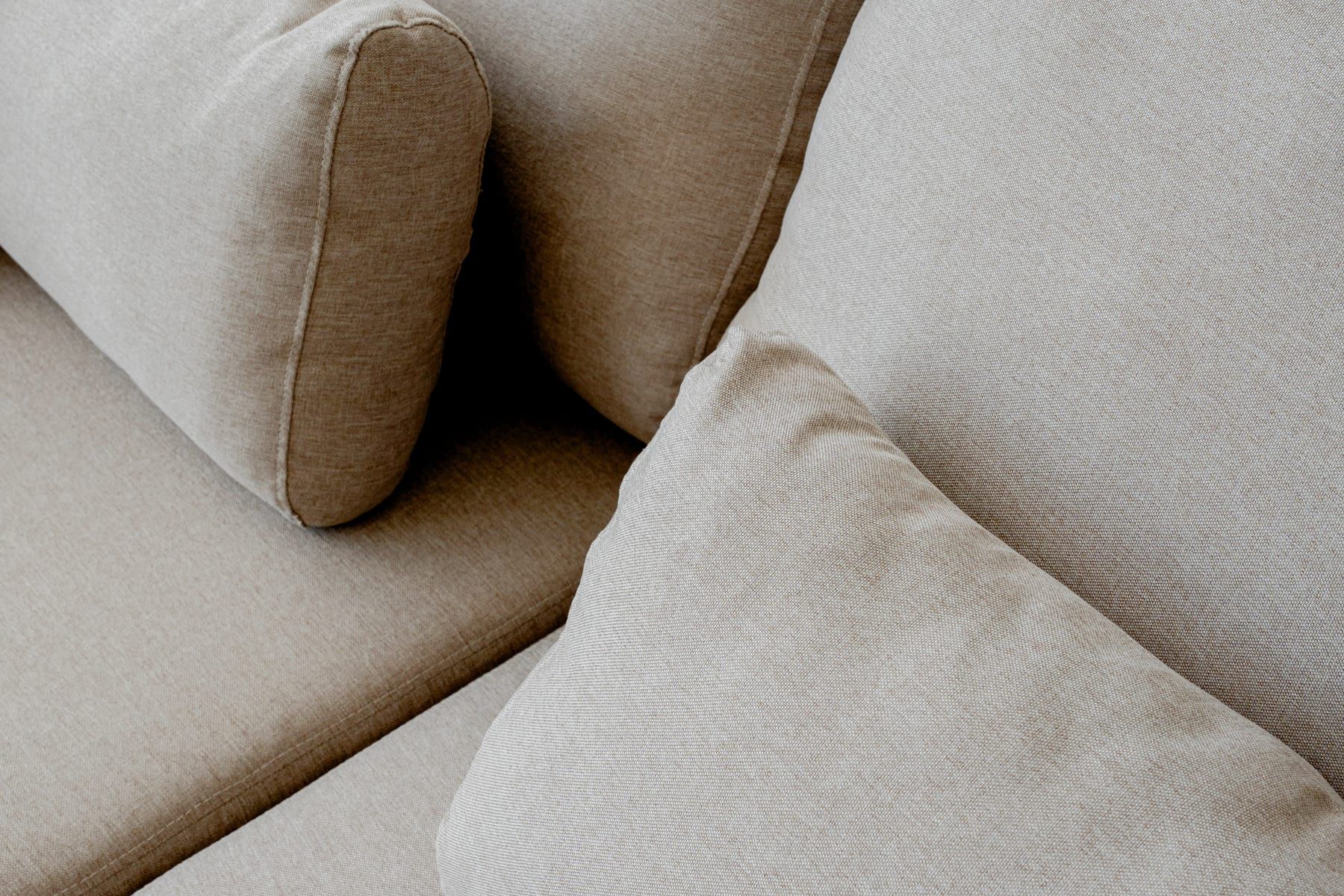
Mold on a sofa comes down to three decisions: what sits on the surface can be cleaned, what got into the foam rarely comes back, and the moisture that caused the mold has to be fixed before any cleaning, or it returns within weeks. My yardsticks are two public sources, the US Environmental Protection Agency (EPA) and the CDC, because I found no Brazilian open guidance with the same level of detail. And I write for the beach house, where average air humidity is above 80 percent and the sofa spends months behind a locked window.
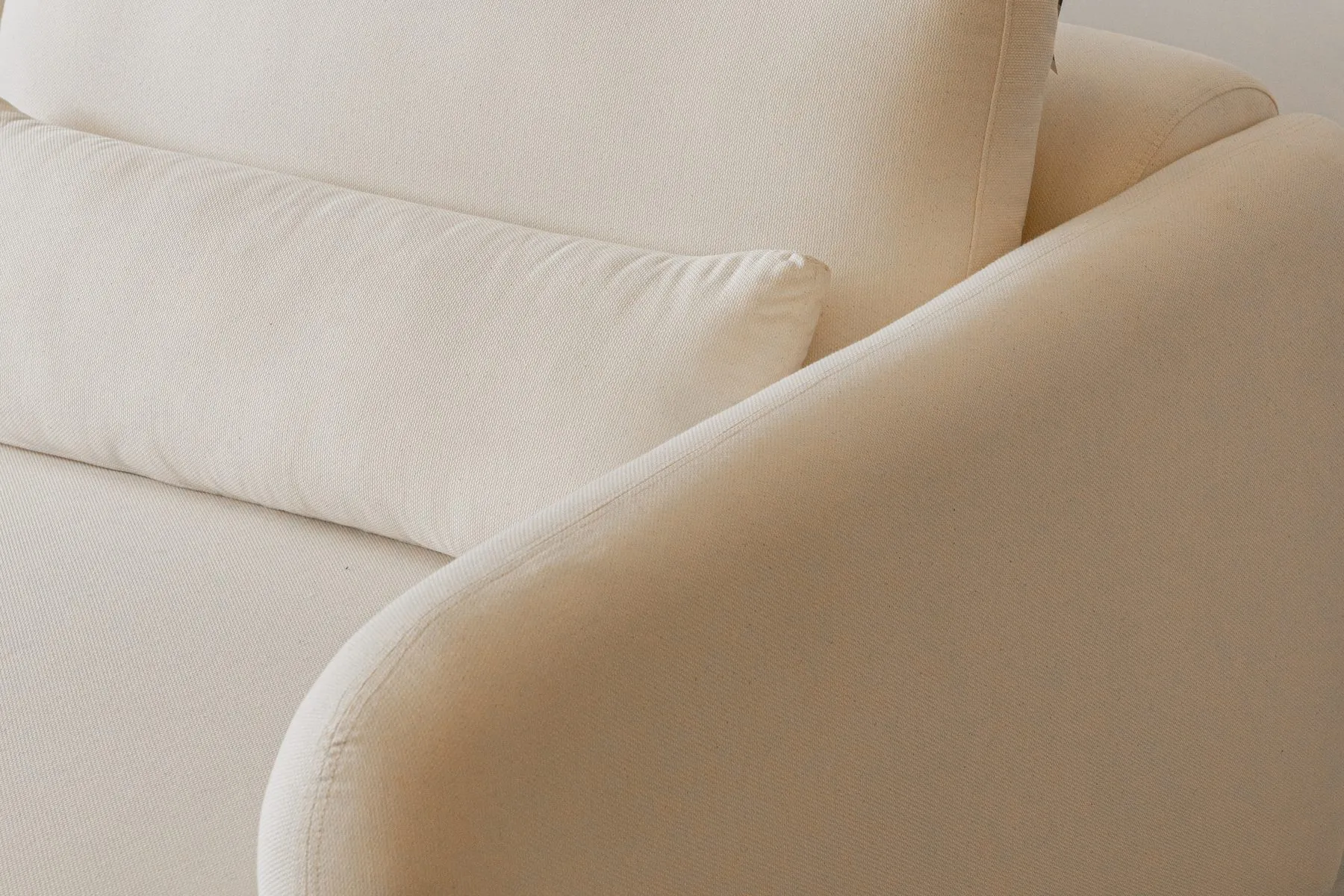
Arm and cushions of a plain-fabric sofa: the tighter the weave, the less room for moisture and dust to settle, but no fabric does without ventilation.
First: where mold comes from
The EPA puts it in one sentence: there is no mold without moisture. It grows where there is water, from a leak, seepage, condensation or simply still, humid air. The agency’s indoor recommendation is humidity below 60 percent, ideally between 30 and 50 percent; the CDC says no higher than 50 percent. On the Sao Paulo coast, INMET’s climatological normal for the Santos station (1981-2010) records an average annual relative humidity of 81.5 percent. With the house open and aired, the air renews itself and the gap is manageable. With the house closed, humid air sits against the upholstery, and mold finds everything it needs.
So before you reach for a cloth, ask: where did the water come from? A wet towel on the seat, a damp wall behind the sofa, air conditioner condensation, a house closed for two months. Each answer leads to a different fix, and the EPA is direct: cleaning mold without fixing the moisture only postpones the problem.
How to remove mold from wood, laminate and metal
For hard surfaces, the EPA recommends scrubbing the mold with detergent and water and drying completely. That covers a tabletop, the side of a buffet, a wooden leg, a metal frame. Two warnings from the same source:
- Do not paint, varnish or caulk over mold. The EPA explains that paint applied over a moldy surface is likely to peel. Clean, dry, fix the moisture and only then redo the finish.
- Absorbent or porous material may not be salvageable. The agency cites ceiling tiles and carpet, and the principle applies to anything that is not a hard surface: mold fills the pores and does not come out with cleaning alone.
Solid wood with a complete finish usually takes surface cleaning well. So does laminate. Where I see the most damage is the underside of the top, the back of the cabinet and the rear of a piece pushed against the wall, exactly the parts with no finish and no airflow. Look there first.
How to remove mold from a sofa and upholstery
Here honesty matters more than a recipe. Follow the order:
- Read the tag. The cleaning code tells you how the fabric can be treated: W takes only water-based cleaners, S takes only solvent, WS or SW take either, and X takes only vacuuming and brushing, no liquid. This is the classification manufacturers such as Ashley Furniture publish, and Lucy Home uses it in the guide to caring for leather and fabric sofas. An X fabric with mold cannot be washed at home.
- Treat the surface according to the code and dry it completely. The EPA insists on drying: material that stays damp after cleaning molds again.
- Judge the depth. A stain only on the cover, with dry foam and no smell, usually has a solution. A stain that went through the fabric, a seat that stays damp, a smell that lingers after drying: the mold is in the foam. The EPA says moldy porous material often has to be thrown away; the CDC says soaked upholstery that could not be dried within 24 to 48 hours should be removed or replaced.
- If the sofa is modular, replace only the module. It is one of the reasons I recommend a modular sofa for a beach house: the damaged module comes out on its own and the others stay. Most Lucy Home sofas are delivered in modules.
I found no recommendation in any of these sources for vinegar, alcohol or bleach on sofa fabric, so I do not recommend them. What the sources say is simpler and less exciting: fix the moisture, treat the surface according to the tag, dry, and when mold has reached the foam, accept that it is over.
A moldy smell with no stain
The EPA treats a moldy smell, on its own, as reason to suspect hidden mold. The places it names, and that I confirm in clients’ homes: the back of the sofa and TV unit against the wall, where condensation forms and air does not move; the underside of the rug; the inside of a closed cabinet; and the upholstery, inside. Pull the furniture out, lift the rug, open the doors and follow the smell. Then find the water: seepage, a window that does not seal, an air conditioner drain.
Mold and health: what the CDC says
I am not a doctor and this text does not replace a consultation. What I record is what the CDC publishes: people with asthma or allergies can have stronger reactions to mold; people with weakened immune systems or chronic lung disease are at risk of infection; for most people the symptoms resemble an allergy. The CDC also says it does not recommend testing to identify the type of mold at home: any mold should be removed and the moisture fixed. The guide to sofa hygiene, dust mites and allergies covers the neighboring subject.
How to prevent mold in a closed house
- Low humidity. The EPA recommends air conditioning and a dehumidifier when needed; the article on a dehumidifier in a beach apartment explains what to expect from one.
- Ventilation whenever the house is in use, with windows open on opposite sides.
- Nothing wet put away or forgotten on the sofa. Drying within 24 to 48 hours is the EPA’s rule.
- Furniture pulled off the wall, so air moves behind it.
- A routine for opening and closing the house. The guide beach house: what to do when you arrive and when you leave has the full list.
When the sofa is beyond saving
If mold reached the foam and the smell stayed, replacement is the honest way out, and the guide when to replace the sofa helps you decide. For the next one to last longer on the coast, I look at a treated wood frame, galvanized staples, foam with a declared density, fabric with a cleaning code and independent modules. The article furniture that lasts on the coast covers each item, and at Lucy Home you check all of it on the spec sheet and by sitting on the sofa.
Come and ask us at the showroom
Lucy Home is at Av. Presidente Kennedy, 3870, Aviação, Praia Grande. Bring a photo of the stain or send it on WhatsApp: the team knows every fabric and every spec sheet, and helps you decide whether to clean, replace a module or start over. Room planning is at no cost. See also the sofas page.
Frequently asked questions
How do I remove mold from a fabric sofa?
First read the cleaning code on the tag (W, S, WS or X), because it tells you whether the fabric takes water. Then, following the EPA, treat the mold on the surface and dry completely; the EPA also says porous material such as fabric and foam, once truly moldy, often has to be thrown away, because mold gets into the pores. The CDC adds that upholstery that was soaked and could not be dried right away should be removed or replaced.
How do I remove mold from wooden furniture?
On a hard surface, the EPA recommends scrubbing with detergent and water and drying completely. Do not paint or varnish over mold: the EPA warns that paint applied over mold is likely to peel. Then fix the moisture that caused the mold, or it comes back.
What do I do about a moldy smell with no visible stain?
The EPA says a moldy smell is reason to suspect hidden mold: behind furniture against the wall, under the rug, inside the upholstery or a cabinet. Find the source and the water feeding it. Room spray only hides the warning.
Is mold bad for your health?
According to the CDC, people with asthma or allergies can have stronger reactions to mold, and people with weakened immune systems or chronic lung disease are at risk of infection. For most people, the CDC describes symptoms like those of an allergy. The CDC does not recommend mold testing at home: if there is mold, what matters is removing it and fixing the moisture.
Sources
- EPA (US Environmental Protection Agency), A Brief Guide to Mold, Moisture and Your Home
- CDC (US Centers for Disease Control and Prevention), About Mold
- Ashley Furniture Industries (furniture manufacturer), Cleaning Codes (W, S, WS/SW and X)
- INMET (Brazil's National Institute of Meteorology), Climatological Normals 1981-2010, relative humidity (station 83782, Santos)